
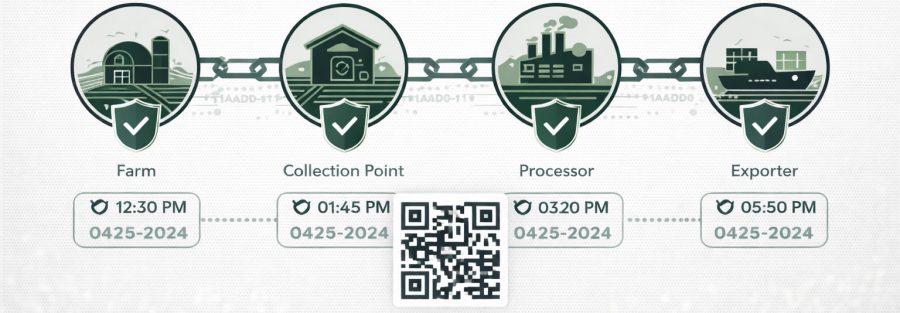
Modern agriculture is no longer just about growing food — it’s about trust.
Consumers want to know where their food comes from. Buyers demand consistent quality. Export markets require strict compliance. Regulators expect accountability. And farmers need fair recognition for what they produce.
In today’s connected world, traceability has become the bridge that links all these expectations together.
From farm to market, knowing the journey of agricultural products is no longer optional — it’s essential.
What is Traceability in Agriculture?
Traceability is the ability to track agricultural produce through every step of the value chain — from the farmer who grows it to the final buyer or consumer.
It answers key questions like:
-
Who produced this crop?
-
Where was it grown?
-
What inputs were used?
-
When was it harvested?
-
Who handled it during processing and transport?
With digital systems, this information can be recorded and verified in real time, creating a transparent and reliable history for every product.
Why Traceability Matters Today
1. Building Trust with Buyers and Consumers
Buyers and consumers increasingly want proof of origin and quality. Traceability provides confidence that products are authentic, safe, and responsibly sourced.
When supply chains are transparent, trust grows.
2. Meeting Compliance and Certification Standards
Export markets and certification bodies often require strict documentation for:
-
Food safety
-
Organic production
-
Fairtrade practices
-
Sustainability standards
Without traceability, meeting these requirements becomes difficult and costly. With digital records, compliance becomes faster and easier.
3. Improving Food Safety
If contamination or quality issues arise, traceability allows organizations to quickly identify the source and isolate affected batches.
Instead of recalling entire shipments, only specific lots are targeted — saving time, money, and reputation.
4. Enabling Responsible Sourcing
Companies are under pressure to demonstrate ethical sourcing and environmental responsibility. Traceability helps verify:
-
Sustainable farming practices
-
No child or forced labor
-
Reduced environmental impact
-
Fair compensation for farmers
This accountability strengthens brand value and market access.
5. Supporting Farmers
Traceability also benefits farmers directly.
When their produce is digitally recorded and verified, farmers:
-
Gain credibility with buyers
-
Access better markets and contracts
-
Receive fairer pricing
-
Build long-term relationships
Visibility leads to opportunity.
6. Smarter Supply Chain Management
With clear data on production volumes and locations, buyers and aggregators can:
-
Forecast supply more accurately
-
Plan logistics efficiently
-
Reduce post-harvest losses
-
Improve coordination across the chain
This leads to lower costs and higher efficiency for everyone.
The Challenge with Traditional Systems
Many supply chains still rely on paper forms, manual logs, or disconnected spreadsheets. These methods are:
-
Error-prone
-
Slow to verify
-
Easy to lose or manipulate
-
Difficult to scale
As agriculture grows more complex, manual systems simply can’t keep up.
Digital traceability systems solve this by creating secure, real-time records accessible to all authorized stakeholders.
The Digital Future of Traceability
Today, technologies like:
-
Mobile data collection
-
GPS farm mapping
-
QR codes
-
Digital ledgers
-
Cloud dashboards
are transforming how agricultural products are tracked.
With a simple scan, stakeholders can trace produce back to its origin, view quality records, and verify compliance instantly.
This level of transparency was once impossible — now it’s becoming standard.
How AgroTrack Supports Traceability
At AgroTrack, we believe traceability starts at the foundation — the farmer.
By digitally registering farmers, mapping farms, tracking production activities, and recording supply chain transactions, AgroTrack enables full visibility from farm to market.
Our platform helps:
-
Farmers become verified producers
-
Buyers source with confidence
-
Exporters meet compliance requirements
-
Partners make data-driven decisions
All within one connected ecosystem.
Traceability is no longer just a “nice to have” feature. It is becoming the backbone of modern agriculture.
As markets demand greater transparency and accountability, organizations that invest in traceability will gain a competitive advantage — while those that don’t risk being left behind.
Because in today’s agricultural economy, knowing the journey of food is just as important as growing it.