
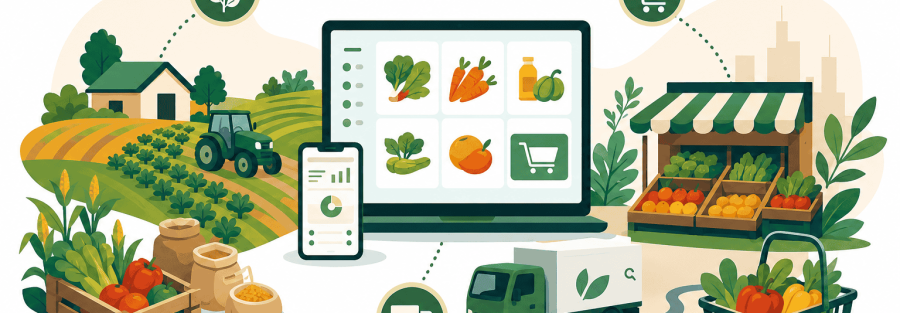
One of the greatest challenges facing agriculture today is not always production—it’s connecting farmers to reliable and profitable markets.
Around the world, millions of farmers produce quality crops but struggle to reach buyers efficiently. At the same time, processors, exporters, retailers, and food manufacturers often face difficulties finding verified suppliers who can consistently meet quality, quantity, and traceability requirements.
This disconnect results in lost income for farmers, supply shortages for buyers, and inefficiencies throughout the agricultural value chain.
A Farm-to-Market Platform helps solve these challenges by digitally connecting every stakeholder involved in agricultural production, aggregation, processing, and distribution.
Modern digital agriculture platforms are transforming how agricultural products move from farms to local, regional, and international markets.
Why Market Access Remains a Challenge
Many agricultural producers face barriers that limit their ability to access profitable markets.
Common challenges include:
- Limited visibility to buyers
- Poor production planning
- Lack of verified farmer information
- Inconsistent product quality
- Weak communication between stakeholders
- Limited traceability
- Inefficient aggregation processes
These challenges reduce farmer incomes while making procurement more expensive for agribusinesses and exporters.
Digital technology provides an opportunity to eliminate many of these inefficiencies.
What Is a Farm-to-Market Platform?
A Farm-to-Market Platform is a digital solution that connects farmers with buyers while providing transparency throughout the agricultural value chain.
Instead of operating independently, farmers, cooperatives, aggregators, processors, exporters, and retailers can collaborate using shared, verified information.
An effective platform integrates:
- Digital farmer registration
- Farm mapping
- Crop production records
- Harvest management
- Produce aggregation
- Quality inspections
- Supply chain tracking
- Buyer connections
- Reporting and analytics
The result is a more efficient agricultural ecosystem that benefits every participant.
Improving Farmer Visibility
The first step toward stronger market access is making farmers digitally visible.
Using a Farmer Management System, organizations can create verified digital farmer profiles that include:
- Farm location
- Crops grown
- Production capacity
- Harvest history
- Cooperative membership
- Quality records
This information helps buyers identify suitable suppliers while enabling cooperatives to coordinate production more effectively.
Strengthening Buyer Confidence
Today’s buyers want more than competitive prices.
They need confidence that agricultural products meet quality, safety, and sustainability standards.
With Agriculture Traceability Software, buyers gain access to verified information such as:
- Product origin
- Farm location
- Harvest dates
- Quality inspection records
- Batch tracking
- QR code verification
This transparency strengthens trust and supports compliance with domestic and international market requirements.
Making Supply Chains More Efficient
Disconnected supply chains often create delays, losses, and unnecessary costs.
Digital farm-to-market platforms improve efficiency by enabling stakeholders to coordinate:
- Harvest schedules
- Produce collection
- Aggregation
- Processing
- Transportation
- Delivery
Real-time visibility helps organizations respond quickly to changing market demand.
Supporting Data-Driven Production
Market demand should influence production planning.
When farmers understand buyer requirements, they can make informed decisions about:
- Crop selection
- Planting schedules
- Expected volumes
- Quality standards
- Harvest timing
Integrated Crop Monitoring Platforms and agricultural analytics help stakeholders align production with market opportunities.
Creating Opportunities for Smallholder Farmers
Smallholder farmers often face the greatest barriers to accessing profitable markets.
Digital platforms reduce these barriers by providing:
- Digital farmer identities
- Production records
- Advisory services
- Market information
- Buyer connections
- Traceability
These tools allow smallholder farmers to participate in formal value chains that were previously difficult to access.
The Role of Analytics
An Agricultural Data Analytics Platform helps organizations understand:
- Production trends
- Supply availability
- Buyer demand
- Regional performance
- Market opportunities
- Farmer productivity
These insights improve planning and enable more strategic business decisions.
Why Connected Agricultural Ecosystems Matter
Agriculture performs best when stakeholders work together rather than in isolation.
Digital platforms connect:
- Farmers
- Cooperatives
- Agronomists
- Input suppliers
- Aggregators
- Processors
- Exporters
- Financial institutions
- Governments
Sharing trusted data improves collaboration and strengthens the resilience of agricultural value chains.
How AgroTrack Cloud Supports Farm-to-Market Connectivity
AgroTrack Cloud is an integrated Digital Agriculture Platform designed to connect agricultural stakeholders through trusted data.
The platform provides:
- Digital farmer profiles
- GPS farm mapping software
- Crop monitoring
- Agricultural traceability software
- Produce aggregation management
- Analytics dashboards
- Farm-to-market connectivity
By digitizing agricultural operations, AgroTrack Cloud helps organizations improve sourcing, increase transparency, strengthen market access, and make data-driven decisions.
Ready to Build Stronger Agricultural Markets?
The future of agriculture depends on connected ecosystems where farmers, buyers, and service providers work together through reliable digital infrastructure.
AgroTrack Cloud empowers organizations to create transparent, efficient, and scalable farm-to-market systems that benefit every stakeholder in the agricultural value chain.
Request a demo today and discover how AgroTrack Cloud can help your organization strengthen market connections and drive sustainable agricultural growth.
Visit: www.agrotrackcloud.com