
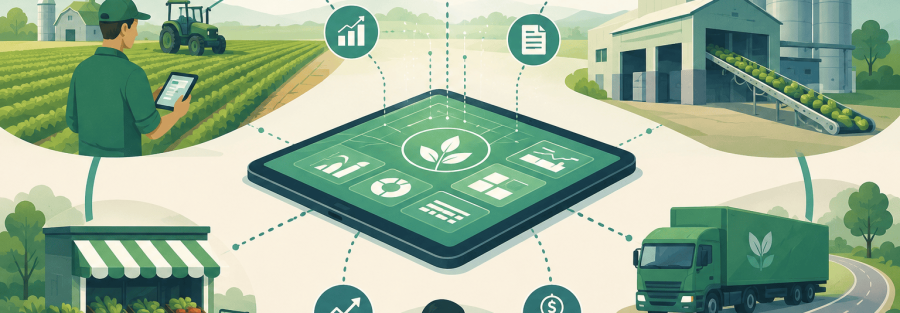
Agriculture is not just about production. It is an interconnected ecosystem involving farmers, cooperatives, aggregators, input suppliers, processors, exporters, financial institutions, retailers, and consumers. The success of the sector depends on how effectively these stakeholders work together.
Yet in many agricultural systems, especially those dominated by smallholder farming, these actors operate in isolation. Farmers struggle to access markets, buyers face sourcing challenges, processors experience inconsistent supply, and financial institutions lack reliable production data for lending decisions.
The result is inefficiency, limited transparency, higher transaction costs, and lost economic opportunities throughout the agricultural sector.
A modern Agricultural Value Chain Platform addresses these challenges by creating a connected digital ecosystem where information flows seamlessly between stakeholders. By combining farmer data, production intelligence, traceability, advisory services, and analytics, a Farm-to-Market Platform helps strengthen collaboration and improve decision-making across the entire agricultural value chain.
AgroTrack Cloud was built to power this transformation by connecting every participant in agriculture through trusted data and digital technologies.
What Is an Agricultural Value Chain Platform?
An Agricultural Value Chain Platform is a digital system that connects stakeholders involved in agricultural production, processing, distribution, financing, and marketing.
Rather than managing disconnected systems and manual processes, organizations can operate within a shared digital environment where information is securely exchanged and updated in real time.
A comprehensive value chain platform typically connects:
- Farmers
- Cooperatives and producer groups
- Agronomists and extension officers
- Input suppliers and agrodealers
- Aggregators
- Processors
- Exporters
- Financial institutions
- Certification bodies
- Governments and development organizations
- Retailers and consumers
By creating a single source of truth, digital platforms improve visibility and collaboration across the agricultural ecosystem.
Why Agricultural Value Chains Need Digital Transformation
Agricultural value chains often face common challenges that limit growth and efficiency.
These include:
- Limited farmer visibility
- Fragmented data systems
- Weak market connections
- Low supply chain transparency
- Poor coordination between stakeholders
- Limited access to agricultural finance
- Inefficient input distribution
Without reliable information, organizations struggle to make informed decisions, manage risks, and scale operations effectively.
An Agricultural Value Chain Platform addresses these issues by providing trusted data and enabling collaboration between all participants in the ecosystem.
Connecting Farmers to Markets
For many farmers, market access remains one of the biggest barriers to growth.
Farmers frequently produce crops without clear information about demand, pricing trends, or potential buyers.
A Farm-to-Market Platform helps bridge this gap by connecting producers directly with processors, exporters, aggregators, and buyers.
Benefits include:
- Improved market visibility
- Better pricing opportunities
- Reduced reliance on intermediaries
- More predictable demand
- Stronger buyer relationships
- Increased farmer income
By improving market access, digital platforms create stronger incentives for productivity and investment.
Improving Farmer Visibility Through Digital Profiles
Effective value chains begin with reliable farmer information.
Digital farmer registration and profiling allow organizations to understand:
- Who is producing specific crops
- Farm locations and sizes
- Production capacity
- Historical yields
- Farming practices
- Cooperative membership
A robust Farmer Management System creates verified digital records that support sourcing, planning, financing, and advisory services.
This visibility allows stakeholders to engage farmers more effectively while improving trust throughout the supply chain.
Strengthening Relationships Between Farmers and Processors
Processors depend on consistent access to quality raw materials.
However, many struggle with supply uncertainty, inconsistent quality standards, and limited production forecasting.
An Agricultural Value Chain Platform enables processors to:
- Identify reliable suppliers
- Monitor production progress
- Forecast supply volumes
- Track quality performance
- Coordinate collection activities
- Improve sourcing efficiency
These capabilities reduce procurement risks while improving operational planning.
Enhancing Agricultural Supply Chain Traceability
Consumers and international markets increasingly demand transparency regarding the origin of agricultural products.
Traceability is becoming essential for food safety, sustainability reporting, certification, and export compliance.
Integrated Agriculture Traceability Software enables organizations to track products from farm to market through:
- Farmer identification
- GPS farm mapping
- Harvest records
- Batch tracking
- Processing records
- Distribution monitoring
- QR code traceability
This strengthens trust while supporting responsible sourcing initiatives.
Supporting Financial Inclusion Across the Value Chain
Access to finance remains a major challenge for many agricultural stakeholders.
Banks and financial institutions often lack sufficient data to evaluate agricultural risk accurately.
A digital value chain platform provides verified records that support:
- Farmer credit scoring
- Agricultural loans
- Input financing
- Crop insurance
- Digital payments
- Investment decisions
Trusted data reduces lending risk while expanding financial opportunities for farmers and agribusinesses.
Improving Input Distribution and Service Delivery
Agricultural productivity depends heavily on timely access to quality inputs and support services.
By connecting input suppliers, agrodealers, and farmers, digital platforms improve:
- Input demand forecasting
- Distribution planning
- Inventory management
- Delivery tracking
- Input usage monitoring
This ensures that farmers receive the products they need when they need them.
Using Data Analytics to Strengthen Value Chains
Data is one of the most valuable assets in modern agriculture.
An integrated Agricultural Data Analytics Platform transforms operational data into actionable intelligence.
Organizations can analyze:
- Farmer distribution
- Crop performance
- Production forecasts
- Input demand trends
- Market supply volumes
- Regional productivity
- Supply chain performance
These insights support strategic planning and improve decision-making across the agricultural ecosystem.
Supporting Sustainable Agriculture and ESG Reporting
Sustainability is becoming increasingly important for buyers, investors, and regulators.
Digital value chain platforms help organizations monitor:
- Climate-smart agriculture practices
- Environmental impact
- Responsible sourcing
- Farmer livelihoods
- Certification compliance
- ESG performance indicators
This information supports sustainability reporting while strengthening access to international markets.
The Future of Farm-to-Market Platforms
The next generation of agricultural value chain platforms will integrate advanced technologies such as:
- Artificial intelligence
- Satellite crop monitoring
- Predictive analytics
- Digital marketplaces
- Blockchain traceability
- IoT farm sensors
- Automated financial services
These innovations will further improve transparency, efficiency, and resilience across agricultural ecosystems.
Why AgroTrack Cloud Is Building Connected Agricultural Ecosystems
AgroTrack Cloud provides a comprehensive Agricultural Value Chain Platform designed to connect every participant in agriculture through trusted data.
The platform integrates:
- Farmer management system
- Digital farmer profiles
- GPS farm mapping software
- Crop monitoring platform
- Digital farmer advisory platform
- Agriculture traceability software
- Agricultural marketplace capabilities
- Agricultural data analytics
By connecting farmers, processors, buyers, financial institutions, and development organizations, AgroTrack Cloud helps create transparent, efficient, and scalable agricultural systems.