
Agriculture is becoming increasingly data-driven, yet millions of farmers worldwide remain invisible within formal agricultural systems. Many agribusinesses, cooperatives, governments, and development organizations still rely on spreadsheets, paper records, and fragmented databases to manage farmer information.
Without reliable farmer data, it becomes difficult to provide advisory services, distribute agricultural inputs, access financing, monitor production, or build transparent supply chains.
This challenge has created growing demand for modern Farmer Management Systems that provide structured digital farmer profiles, centralized farmer records, and real-time visibility across agricultural value chains.
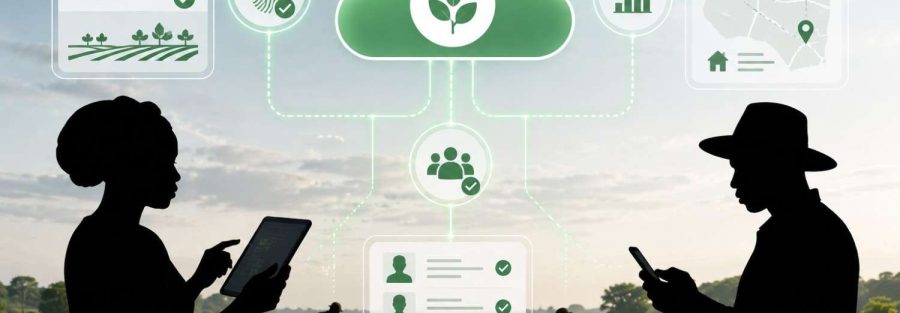
AgroTrack Cloud addresses this challenge by providing a comprehensive platform that enables organizations to digitize farmers, map farms, monitor production, and connect stakeholders through a single agricultural ecosystem.
Why Farmer Data Matters More Than Ever
Farmer data is becoming one of the most valuable assets in modern agriculture.
Organizations need accurate information to answer critical questions:
- Who are the farmers producing crops?
- Where are their farms located?
- What crops are they growing?
- What is their production capacity?
- What inputs have they received?
- What advisory services have been provided?
- What markets are they supplying?
Without structured answers to these questions, agricultural planning becomes difficult and inefficient.
A modern Farmer Information Management System helps organizations capture, organize, and analyze farmer data in ways that improve decision-making and operational efficiency.
What Is a Farmer Management System?
A Farmer Management System is a digital platform that helps agricultural organizations register, manage, monitor, and engage farmers through centralized records and workflows.
Rather than relying on disconnected spreadsheets and paper forms, organizations can manage all farmer information through one platform.
Key capabilities include:
Digital Farmer Profiles
Every farmer receives a structured digital profile containing:
- Personal information
- Farm information
- Production history
- Crop records
- Livestock information
- Contact details
- Cooperative membership records
These profiles create a reliable digital identity that can support multiple agricultural programs and services.
Farmer Registration System
A modern Farmer Registration System enables organizations to onboard thousands of farmers efficiently while maintaining data quality and consistency.
Digital registration improves:
- Data accuracy
- Verification processes
- Reporting capabilities
- Farmer visibility
How Digital Farmer Profiles Improve Agricultural Programs
Many agricultural projects struggle because they lack accurate baseline data.
When organizations use digital farmer profiles, they can:
Improve Targeting
Programs can identify specific farmer groups based on:
- Location
- Crops grown
- Production capacity
- Farm size
- Advisory needs
This allows resources to be allocated more effectively.
Enhance Monitoring and Evaluation
Development projects, NGOs, and governments require measurable impact data.
Digital farmer profiles make it easier to track:
- Farmers reached
- Farms mapped
- Inputs distributed
- Yield improvements
- Training participation
This improves accountability and reporting.
Strengthen Farmer Engagement
Structured farmer records enable personalized communication and support.
Organizations can deliver:
- Advisory alerts
- Training content
- Weather updates
- Input recommendations
- Market information
at the right time and to the right audience.
GPS Farm Mapping: Building Agricultural Visibility
Farmer data alone is not enough.
Agricultural organizations also need visibility into farm locations and land use patterns.
This is where GPS Farm Mapping Software becomes critical.
GPS mapping enables:
- Farm boundary mapping
- Farm size verification
- Production area analysis
- Regional planning
- Resource allocation
By linking digital farmer profiles to mapped farms, organizations gain a complete picture of their agricultural operations.
This creates a stronger foundation for production monitoring, traceability, and financing.
Connecting Farmer Data to Agricultural Supply Chains
Modern supply chains require transparency.
Buyers, exporters, processors, and certification bodies increasingly need verified information about producers and production practices.
A structured Farmer Database Management System supports:
- Agricultural supply chain tracking
- Product sourcing verification
- Compliance monitoring
- Sustainability reporting
When farmer records are connected to production data and traceability systems, organizations can build stronger and more trusted supply chains.
Supporting Agricultural Financing Through Trusted Data
Access to finance remains one of the biggest barriers facing farmers globally.
Financial institutions often struggle to assess agricultural risk because farmer records are incomplete or unavailable.
A digital farmer management platform can provide:
- Production history
- Farm size verification
- Crop performance data
- Input usage records
- Historical activity logs
These data points help support:
- Farmer credit scoring
- Agricultural loans
- Input financing programs
- Crop insurance initiatives
Trusted data creates new opportunities for financial inclusion.
Creating a Connected Agricultural Ecosystem
Agriculture works best when stakeholders are connected.
Farmers, agronomists, cooperatives, input suppliers, buyers, processors, exporters, and financial institutions all depend on accurate information.
An integrated Agricultural Ecosystem Platform enables collaboration through shared data and connected workflows.
AgroTrack Cloud helps organizations create this ecosystem by combining:
- Farmer onboarding software
- Farmer database management
- GPS farm mapping software
- Crop advisory platforms
- Agricultural supply chain tracking
- Agriculture traceability software
- Agricultural analytics dashboards
The result is a more efficient, transparent, and scalable agricultural system.
Why Organizations Are Investing in Farmer Management Systems
Organizations adopting digital farmer management solutions are seeing measurable benefits:
✓ Improved farmer visibility
✓ Faster farmer onboarding
✓ Better reporting and analytics
✓ Enhanced traceability and compliance
✓ Improved advisory delivery
✓ Stronger market linkages
✓ Better access to agricultural financing
✓ Increased operational efficiency
As agriculture becomes increasingly digital, structured farmer data will become a competitive advantage.
The Future of Farmer Data Management
The future of agriculture will be built on trusted data.
Digital farmer profiles will become the foundation for:
- AI-powered farming recommendations
- Precision agriculture systems
- Climate-smart agriculture initiatives
- Agricultural marketplaces
- Traceability programs
- Digital financial services
Organizations that invest in farmer data infrastructure today will be better positioned to succeed in tomorrow’s agricultural economy.
Ready to Digitize Your Agricultural Operations?
AgroTrack Cloud provides a powerful Farmer Management System designed to help organizations create digital farmer profiles, improve agricultural visibility, strengthen traceability, and unlock data-driven decision-making.
Whether you are a cooperative, agribusiness, NGO, government agency, exporter, or financial institution, AgroTrack Cloud can help you build a connected agricultural ecosystem.
Request a Demo Today and discover how trusted farmer data can transform your agricultural operations.
Visit: www.agrotrackcloud.com